
/ The Citadel
In The Sky
The Heavenly
Palace
Citadel Colelction draws upon the rich tapestry of Chinese mythology, specifically the celestial realm known as the Heavenly Palace (天宫) depicted in the folklore ''Journey To The West" — a divine citadel presided over by the Jade Emperor, ruler of the heavens. According to legend, this palace spans thirty-three levels and houses myriad deities, forming an ethereal cosmos of order, power, and hierarchy. The series reimagines this mythic landscape through four illuminated objects, each envisioned as a sacred bastion suspended in the sky.


02.

01.

03.

The 33 Heavens
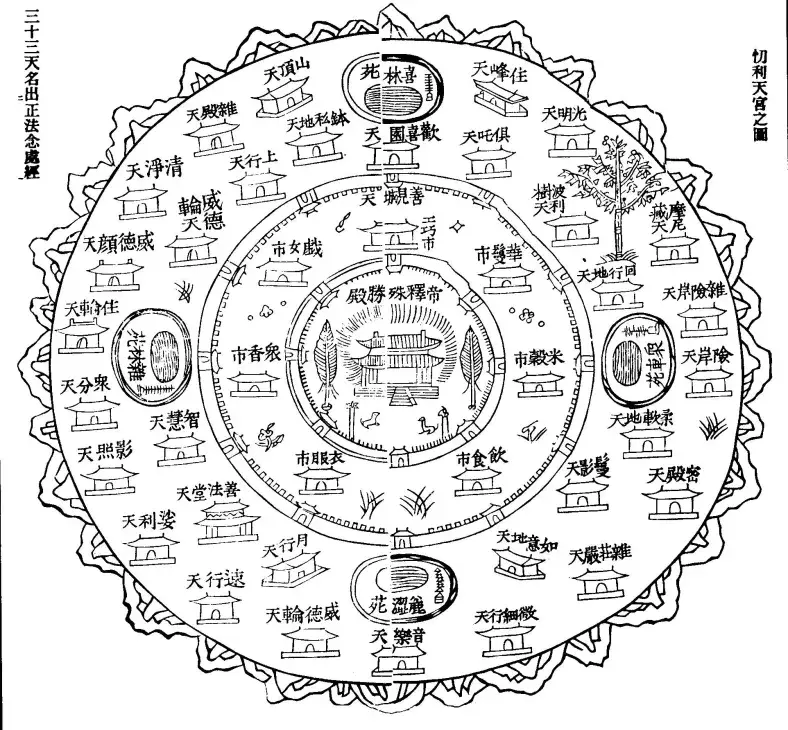
In Buddhist cosmology, the Thirty-Three Heavens are known as Trāyastriṃśa, literally “the realm of the Thirty-Three.” They form one of the celestial realms within Mount Sumeru, the cosmic mountain at the centre of the Buddhist universe.
At its summit resides Śakra (帝释天, Dìshìtiān), known in Chinese Buddhism as Indra, the ruler of the Thirty-Three Heavens. He is not a creator god, but a powerful celestial being who governs the realm and protects the Buddhist Dharma.
The number thirty-three comes from the traditional Buddhist cosmological scheme in which Śakra is surrounded by thirty-two other great deities, making thirty-three celestial rulers in total. The heavens are therefore imagined less as a single physical “sky” and more as a hierarchical celestial realm populated by gods, immortals and divine beings.
The Heavenly
Palace
Citadel Colelction draws upon the rich tapestry of Chinese mythology, specifically the celestial realm known as the Heavenly Palace (天宫) depicted in the folklore ''Journey To The West" — a divine citadel presided over by the Jade Emperor, ruler of the heavens. According to legend, this palace spans thirty-three levels and houses myriad deities, forming an ethereal cosmos of order, power, and hierarchy. The series reimagines this mythic landscape through four illuminated objects, each envisioned as a sacred bastion suspended in the sky.

02.

01.
03.
The 33 Heavens
In Buddhist cosmology, the Thirty-Three Heavens are known as Trāyastriṃśa, literally “the realm of the Thirty-Three.” They form one of the celestial realms within Mount Sumeru, the cosmic mountain at the centre of the Buddhist universe.
At its summit resides Śakra (帝释天, Dìshìtiān), known in Chinese Buddhism as Indra, the ruler of the Thirty-Three Heavens. He is not a creator god, but a powerful celestial being who governs the realm and protects the Buddhist Dharma.
The number thirty-three comes from the traditional Buddhist cosmological scheme in which Śakra is surrounded by thirty-two other great deities, making thirty-three celestial rulers in total. The heavens are therefore imagined less as a single physical “sky” and more as a hierarchical celestial realm populated by gods, immortals and divine beings.
Intepretations
Buddhist cosmology generally divides existence into multiple realms of rebirth. The Thirty-Three Heavens belong to the desire realm (Kāmadhātu). Their inhabitants possess extraordinary longevity and supernatural abilities, but they are still caught within saṃsāra. They are not eternal and have not escaped the cycle of birth and death.
Daoist cosmology, meanwhile, developed a much more elaborate architecture of heavens. Different Daoist traditions describe different numbers and hierarchies, including systems of Thirty-Six Heavens and other celestial divisions. These heavens are inhabited by celestial officials, immortals and divine beings, and are often organised into increasingly exalted levels.
Chinese popular religion eventually layered these systems together. Buddhist Buddhas and bodhisattvas, Daoist immortals, the Jade Emperor, ancient Chinese gods and local deities could all coexist within one enormous cosmological universe.
That hybrid universe is essentially the world of Journey to the West.
04.


05
06

Intepretations
Buddhist cosmology generally divides existence into multiple realms of rebirth. The Thirty-Three Heavens belong to the desire realm (Kāmadhātu). Their inhabitants possess extraordinary longevity and supernatural abilities, but they are still caught within saṃsāra. They are not eternal and have not escaped the cycle of birth and death.
Daoist cosmology, meanwhile, developed a much more elaborate architecture of heavens. Different Daoist traditions describe different numbers and hierarchies, including systems of Thirty-Six Heavens and other celestial divisions. These heavens are inhabited by celestial officials, immortals and divine beings, and are often organised into increasingly exalted levels.
Chinese popular religion eventually layered these systems together. Buddhist Buddhas and bodhisattvas, Daoist immortals, the Jade Emperor, ancient Chinese gods and local deities could all coexist within one enormous cosmological universe.
That hybrid universe is essentially the world of Journey to the West.
04.

05
06
